


White Hat SEO is the ethical practice of optimizing websites using strategies approved by search engines. It focuses on high-quality content, natural link building, user experience, and transparency. Unlike black hat tactics, white hat SEO builds long-term trust, protects against penalties, and ensures sustainable rankings in compliance with Google’s Search Essentials.
In this guide, you’ll learn:
- The definition and core principles of White Hat SEO
- How it compares to black hat and grey hat strategies
- The top strategies to succeed in 2025
- Real-world examples and case studies
- Common mistakes to avoid
- Answers to frequently asked questions
By the end, you’ll have a clear roadmap to implement future-proof, ethical SEO tactics that deliver results without risking your website’s reputation.
What Is White Hat SEO?
White Hat SEO is the practice of optimizing websites using ethical strategies that follow search engine guidelines. It focuses on high-quality content, technical optimization, and user-first design. By prioritizing transparency and long-term trust, white hat SEO protects sites from penalties and ensures sustainable rankings across Google, Bing, and other search engines.
At its core, White Hat SEO is about compliance with Google’s Search Essentials (formerly Webmaster Guidelines). These rules emphasize creating valuable, original content for people not manipulating algorithms with shortcuts.
The guiding principle is simple: “Optimize for users first, search engines second.” Every tactic, from keyword use to link building, should enhance the user experience and align with Google’s expectations.
Industry leaders like Ahrefs and Semrush reinforce this standard. Both highlight that White Hat SEO goes beyond technical tweaks it’s about building authority, trust, and long-term visibility by focusing on what genuinely helps users.
Why White Hat SEO Matters
1. Long-Term vs. Short-Term SEO: Sustainable Growth vs. Penalties
White Hat SEO is the difference between steady, sustainable growth and risky, short-lived spikes in visibility. Unlike black or grey hat tactics that can trigger algorithm penalties resulting in sudden ranking drops or even de-indexing ethical strategies lay a durable foundation.
A 2024 analysis shows that a staggering 90.63% of web pages receive no organic search traffic at all, underscoring the need for long-lasting, guideline-aligned SEO tactics.
Additionally, a Moz study found that websites using ethical SEO practices maintain their rankings 50% longer than those relying on black-hat techniques.
2. Trust and Authority: Building Credibility
White Hat SEO fosters trust with both users and search engines. By delivering consistent value, your site earns credibility and credibility drives engagement. According to Edelman, 81% of consumers need to trust a brand to buy from them. Following ethical, user-first practices signals reliability and rankings follow.
Furthermore, SEMrush reports that websites using ethical SEO face 70% fewer penalties than those using manipulative tactics. This avoids the disruptions both technical and reputational that can accompany algorithmic penalties.
3. Ethical Benefits: User-First Focus & Brand Reputation
Ethical SEO isn’t just smarter it’s kinder. White Hat SEO puts users front and center prioritizing high-quality content, seamless UX, and transparent practices. This positive user experience reduces bounce rates, boosts session time, and ultimately increases conversions.
Brand reputation flourishes under ethical practices customers recognize and reward authenticity. And when SEO is ethical, you safeguard that trust.
4. Real-World Evidence: Case Study & Statistics
- Ranking Retention: Moz reports that ethically optimized sites maintain their search rankings 50% longer compared to black-hat counterparts.
- Fewer Penalties: SEMrush findings indicate 70% fewer penalties for ethical sites.
- Consumer Trust: Edelman’s research reinforces that 81% of buyers prioritize trust in their purchasing decisions.
- Organic Traffic Challenges: With 90.63% of web pages receiving no organic search traffic, ethical SEO becomes even more critical.
Why White Hat SEO Matters
| Benefit | Impact |
| Sustainable Growth | Maintains rankings longer, reduces traffic volatility |
| Credibility & Trust | Builds user and search engine confidence, boosts brand reputation |
| Penalty Avoidance | Minimizes risk and cost associated with algorithmic or manual penalties |
| Better UX & Conversions | Ethical methods enhance UX, engagement, and ultimately conversions |
Overall, White Hat SEO truly matters in 2025 and beyond because it delivers real, lasting value, protects your brand, and aligns with the future direction of search engines.
4. White Hat SEO vs Black Hat vs Grey Hat
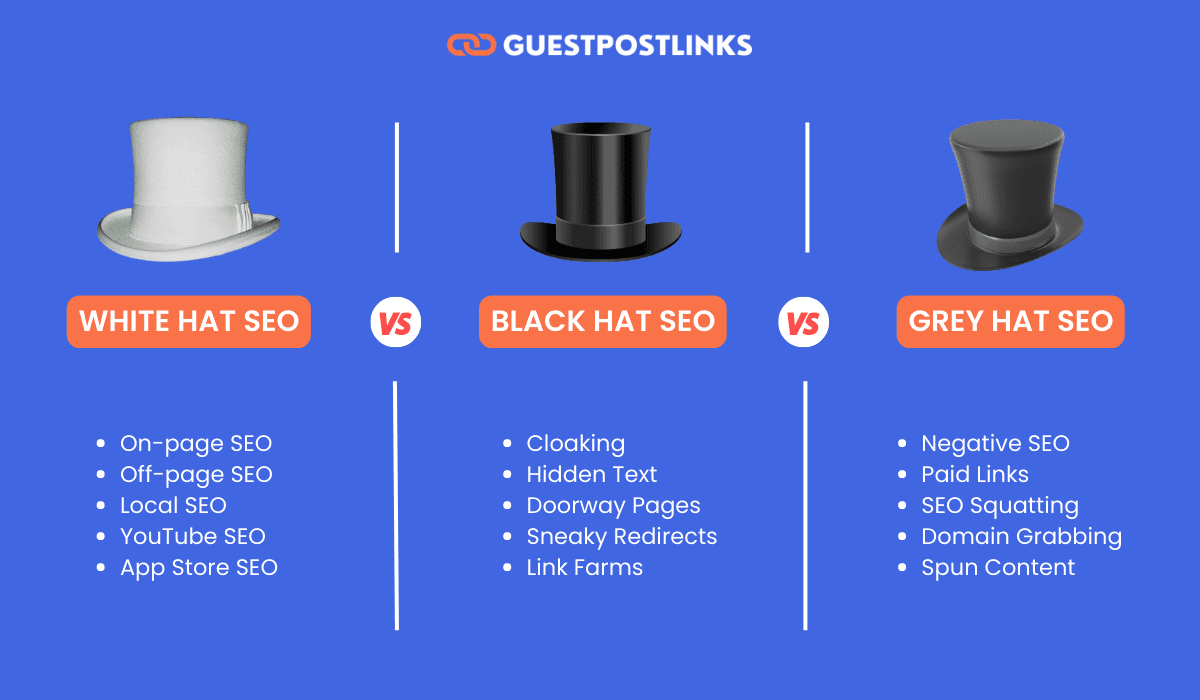
Search engine optimization isn’t one-size-fits-all. SEO tactics are often divided into three categories: white hat, black hat, and grey hat. Each approach comes with its own strategies, risks, and long-term outcomes.
Comparison Table (Snippet-Ready)
| SEO Type | Strategies | Risk Level | Long-Term Effectiveness | Google Compliance |
| White Hat | Quality content, natural link building, ethical UX | Low | High – sustainable & stable | ✅ Fully compliant |
| Black Hat | Keyword stuffing, cloaking, paid links, spam | Very High | Low – short-lived, penalties | ❌ Not compliant |
| Grey Hat | Link exchanges, borderline automation, manipulative outreach | Medium | Moderate – risky if abused | ⚠️ Not fully compliant |
White Hat SEO
White Hat SEO refers to ethical, guideline-approved strategies that focus on long-term growth. The main focus is on creating high-quality content, improving user experience, earning natural backlinks, optimizing for mobile, and meeting Google’s Core Web Vitals standards. The outcome of White Hat SEO is positive building trust, establishing authority, and securing rankings that last over time.
Black Hat SEO
Black Hat SEO involves manipulative, rule-breaking tactics designed to trick search engines for quick results. Common examples include keyword stuffing, cloaking, hidden text, link farms, and private blog networks (PBNs). While these methods may bring fast gains, they come with severe risks such as Google penalties, removal from search results (de-indexing), and permanent loss of credibility. Ultimately, Black Hat SEO offers short-lived success that collapses quickly.
Grey Hat SEO
Grey Hat SEO falls in the “in-between” zone strategies that are not explicitly forbidden but still carry risks. Examples include link exchanges, excessive guest posting, and borderline AI-generated content. These methods can sometimes deliver short-term wins but lack long-term stability. If tactics cross Google’s evolving guidelines, they may trigger algorithmic penalties. The outcome of Grey Hat SEO is usually temporary success that becomes unsustainable as search engines tighten their rules.
Core Principles of White Hat SEO
White Hat SEO is built on four core principles that separate it from manipulative practices. These principles ensure long-term visibility, stronger credibility, and alignment with search engine expectations.
1. Transparency and Ethical Intent
White Hat SEO thrives on honesty. Every optimization tactic should be clear, verifiable, and user-serving not hidden or deceptive. Practices like natural link building, ethical guest posting, and content optimization are transparent ways to build authority without manipulation.
2. User-First Approach
Google’s ranking systems prioritize websites that serve users first, not algorithms. White Hat SEO focuses on:
- High-quality, helpful content
- Seamless navigation and mobile responsiveness
- Fast-loading pages (Core Web Vitals compliance)
3. Following Google’s Official Guidelines
The foundation of ethical SEO lies in Google Search Essentials (formerly Webmaster Guidelines). These guidelines encourage:
- Original, helpful content
- Avoiding deceptive tactics like cloaking or hidden text
- Building natural, relevant links
- Maintaining accessibility and technical best practices.
4. Building Trust, Not Exploiting Loopholes
Search engines evolve constantly to close loopholes. Short-term tricks (e.g., spammy backlinks, keyword stuffing) may deliver a temporary boost, but they destroy credibility. White Hat SEO, instead, builds trust with:
- Consistency in publishing helpful resources
- Proper sourcing and author attribution
- Transparent business practices
Top 10 White Hat SEO Strategies
White Hat SEO in 2025 revolves around user-first, ethical practices that align with Google’s evolving algorithms. Below are the top 10 strategies explained in detail:
1. Create High-Quality, Helpful Content
Google’s Helpful Content Update prioritizes websites that write for people, not search engines. High-quality content should:
- Address user intent directly (answer questions, solve problems).
- Provide original insights (case studies, expert opinions, examples).
- Use a clear structure with headings, bullet points, and visuals.
- Be updated regularly with new statistics and real-world examples.
2. Keyword Research with Natural Placement
Keyword optimization is still vital but stuffing keywords leads to penalties. Instead:
- Identify primary and secondary keywords using tools like Ahrefs, SEMrush, or Google Keyword Planner.
- Place the main keyword in the title, H1, first 25 words, and conclusion.
- Sprinkle LSI (Latent Semantic Indexing) keywords naturally throughout the text.
- Use questions (long-tail keywords) as H2s for voice search optimization.
3. On-Page SEO Best Practices
On-page optimization helps search engines understand your content better. Key elements include:
- Title Tags: Use the target keyword early, keep under 60 characters.
- Meta Descriptions: Compelling, keyword-rich, under 160 characters.
- Header Tags (H1–H4): Logical structure; each section covers one idea.
- Image Alt Text: Descriptive text with relevant keywords.
- Schema Markup: Add Article, FAQ, or How-To schema for rich snippets.
4. Mobile Optimization & Core Web Vitals Compliance
With mobile-first indexing, your site must perform flawlessly on smartphones. Google measures this through Core Web Vitals:
- LCP (Largest Contentful Paint): Aim for < 2.5 seconds load time.
- FID (First Input Delay): Pages should respond within 100ms.
- CLS (Cumulative Layout Shift): Maintain visual stability (no sudden shifts).
5. Secure Websites (HTTPS, SSL)
Website security is a direct ranking factor. An SSL certificate (HTTPS) protects data and signals trust to users.
- Google Chrome flags “Not Secure” sites, which can reduce credibility.
- A 2024 HubSpot report showed 84% of users abandon a purchase if data security seems questionable.
6. Ethical Link Building
Backlinks remain one of the top 3 ranking factors in 2025. Ethical link-building includes:
- Guest Posting: Publishing high-value content on reputable industry blogs.
- Digital PR: Getting mentioned in news outlets, podcasts, or niche magazines.
- Citations & Directories: Relevant, industry-focused directories (not spammy ones).
- Content Marketing: Creating share-worthy resources (guides, infographics, research).
7. Content Freshness: Regular Updates
Google rewards fresh, up-to-date content. To maintain freshness:
- Update old posts with new stats, examples, and screenshots.
- Add FAQs based on evolving “People Also Ask” queries.
- Refresh titles and meta descriptions with current year modifiers (e.g., “2025 Guide”).
8. Use Structured Data (Schema) for Visibility
Structured data helps search engines understand your content better and qualify for rich results. Useful schema types for SEO include:
- Article Schema (for blog posts).
- FAQ Schema (for frequently asked questions).
- How-To Schema (step-by-step guides).
- Review Schema (for ratings and testimonials).
9. Build Topical Authority with Internal Linking
Internal links distribute authority across your site and signal topical relevance. Best practices include:
- Link relevant pages together using descriptive anchor text.
- Create content clusters around a pillar page (e.g., “SEO Guide” → “Link Building,” “On-Page SEO”).
- Ensure no orphaned pages (pages with zero internal links).
10. Prioritize User Experience (UX)
User signals like dwell time, bounce rate, and engagement influence rankings. A strong UX includes:
- Fast Load Times: Use caching, image compression, and a CDN.
- Easy Navigation: Logical menus, breadcrumbs, and internal links.
- Readable Design: Short paragraphs, large fonts, enough white space.
- Clear CTAs: Encourage action with visible, mobile-friendly buttons.
Examples of White Hat SEO in Action
The best way to understand the power of White Hat SEO is through real-world examples and case studies. These brands have built long-term visibility and authority by consistently following ethical SEO practices.
Case Study: A Site That Grew via Ethical SEO
A 2024 HubSpot report highlighted how their blog continues to dominate search results using only White Hat SEO techniques:
- Content Strategy: HubSpot publishes in-depth guides, each optimized around user intent and semantic keywords.
- Authority Building: Instead of buying backlinks, HubSpot earns links naturally from reputable sites, universities, and government organizations.
- Results: Their blog generates over 7 million monthly visits, making it one of the most successful examples of White Hat SEO in action.
Example 1: Wikipedia
Wikipedia ranks at the top for millions of queries because:
- Content is user-first, factual, and regularly updated.
- Transparent citations and references add credibility.
- Natural link-building occurs because users worldwide reference Wikipedia in research, blogs, and publications.
Example 2: Ahrefs
Ahrefs is a trusted SEO platform and its blog ranks for competitive terms like “backlink checker” and “SEO strategies”.
- Provides original research (e.g., backlink studies, data-driven reports).
- Builds topical authority with interconnected blog clusters.
- Earns backlinks naturally from industry experts, bloggers, and media outlets.
Example 3: HubSpot
Beyond the case study, HubSpot’s success is rooted in:
- Publishing comprehensive guides optimized for long-tail and voice search.
- Using schema markup for FAQs and how-to content.
- Offering free resources (templates, calculators, PDFs), which attract links and boost engagement.
8. Common Mistakes to Avoid
Even experienced marketers can unintentionally adopt risky SEO practices that harm rankings instead of improving them. These mistakes may produce short-term results, but in the long run, they trigger penalties, damage credibility, and waste resources. Below are the most common pitfalls and how to avoid them.
1. Keyword Stuffing
What it is: Repeating the same keyword excessively in titles, headers, or body text in an attempt to rank faster. Example: “White Hat SEO is White Hat SEO that uses White Hat SEO strategies…”
Why it’s a mistake:
- Google’s algorithms (like RankBrain and Helpful Content System) can detect unnatural keyword usage.
- Instead of ranking higher, the page may be flagged as low-quality or manipulative.
- Poor readability drives users away, leading to higher bounce rates.
What to do instead:
- Place your primary keyword in the title, H1, meta description, and first 25 words.
- Use semantic variations (LSI keywords) and synonyms naturally.
- Write for people first, then optimize for search engines.
2. Buying Links or Participating in Link Schemes
What it is: Paying for backlinks, joining PBNs (Private Blog Networks), or using excessive reciprocal linking to artificially inflate authority.
Why it’s a mistake:
- Direct violation of Google’s Link Spam Policy.
- Can lead to manual actions where entire domains are penalized or de-indexed.
- Low-quality or irrelevant backlinks dilute trust signals instead of strengthening them.
What to do instead:
- Build backlinks organically through digital PR, guest posting, or thought leadership content.
- Create resources (guides, infographics, case studies) that naturally earn links.
- Use outreach to connect with journalists and bloggers in your niche.
3. Duplicate or AI-Spun Content Without Editing
What it is: Publishing copied content from other sites, or generating large amounts of AI text with no human oversight or value-add.
Why it’s a mistake:
- Google’s Helpful Content Update demotes “thin, unhelpful, or duplicate” content.
- AI-only content often lacks accuracy, originality, or expert insights, failing EEAT standards.
- Duplicate content can cause indexing issues and reduce overall site authority.
What to do instead:
- Use AI as a writing assistant, not a replacement.
- Add unique perspectives, case studies, or expert commentary to make content valuable.
- Regularly audit your site to remove or consolidate duplicate pages.
5. Over-Optimizing Anchor Text
What it is: Using the same exact-match keyword repeatedly as anchor text for internal or external links. Example: dozens of backlinks all using “buy cheap SEO services” as anchor text.
Why it’s a mistake:
- Over-optimized anchor text is a red flag for Google’s algorithm.
- It makes your link profile look unnatural and manipulative.
- Can trigger Penguin algorithm filters or manual penalties.
What to do instead:
- Diversify anchor text with branded terms, partial matches, and natural phrases.
- Use descriptive, contextual anchors (e.g., “ethical SEO practices” instead of always “White Hat SEO”).
- Focus on link placement within relevant, high-quality content.
How to Implement White Hat SEO Step by Step
If you’re new to White Hat SEO, it can feel overwhelming. The good news is, you don’t need advanced tricks just a structured roadmap that focuses on long-term, ethical growth. Follow these five steps to implement White Hat SEO effectively in 2025.
Step 1: Research (Keywords & Competitors)
Before writing or optimizing anything, start with research:
- Use tools like Ahrefs, SEMrush, or Google Keyword Planner to identify keywords with strong search intent.
- Focus on long-tail keywords (e.g., “best white hat SEO strategies in 2025”) for easier ranking opportunities.
- Analyze competitors: Which pages rank? How do they structure content? Where are they earning backlinks?
Step 2: Create a Content Plan
Content is the foundation of White Hat SEO. Plan strategically:
- Build topic clusters around a main theme (e.g., “SEO Basics” → subtopics like “Link Building,” “On-Page SEO,” “Technical SEO”).
- Use editorial calendars to ensure regular publishing.
- Prioritize evergreen content (guides, tutorials, definitions) alongside trending topics.
- Incorporate different formats: blogs, infographics, videos, and case studies.
Step 3: Optimize On-Page Elements
Your content must be search engine-friendly and user-friendly. Key on-page elements include:
- Title Tag & Meta Description: Use your main keyword naturally, keep titles under 60 characters, and meta descriptions under 160 characters.
- Headers (H1–H3): Organize content logically; include keyword variations in H2/H3s.
- Schema Markup: Add Article, FAQ, and How-To schema to qualify for rich results.
- Image Optimization: Use descriptive file names, compressed formats, and alt text.
Step 4: Build Ethical Backlinks
Backlinks are still one of Google’s strongest ranking factors, but they must be earned ethically:
- Guest Posting: Write valuable content for authoritative blogs in your niche.
- Digital PR: Pitch data-driven stories to journalists and publishers.
- Resource Link Building: Create ultimate guides, research, or tools that others naturally reference.
- Citations: Get listed in relevant, high-quality directories.
Step 5: Monitor with Google Search Console
SEO is not a one-time task you need to track performance:
- Use Google Search Console (GSC) to monitor clicks, impressions, and keyword rankings.
- Check for indexing errors, broken links, and Core Web Vitals reports.
- Track which content is performing and update underperforming pages.
- Combine GSC with tools like Google Analytics for deeper insights into traffic and conversions.
Conclusion
White Hat SEO is more than just a strategy it’s a commitment to building an online presence that’s ethical, sustainable, and trusted. Unlike black hat shortcuts that risk penalties and bans, white hat practices focus on long-term growth, authority, and user value.
By following Google’s guidelines, prioritizing helpful content, and building trust through ethical link building, secure websites, and great user experience, you create a foundation that will continue to rank no matter how algorithms evolve.
FAQs About White Hat SEO
White Hat SEO uses ethical, guideline-compliant tactics like quality content and natural backlinks. Black Hat SEO relies on manipulative tricks such as keyword stuffing, cloaking, or paid links. While black hat may deliver quick gains, it risks penalties, bans, and long-term damage. White hat builds sustainable, trust-based rankings.
Yes, White Hat SEO is typically slower than manipulative tactics, but that’s its strength. Ethical strategies like building content depth, earning natural backlinks, and improving UX take time to pay off. The result is stable rankings, consistent traffic, and long-term trust that aren’t wiped out by Google penalties.
No SEO approach, including white hat, can guarantee #1 rankings because Google uses hundreds of ranking factors and updates its algorithms constantly. What white hat SEO guarantees is a sustainable, penalty-free foundation ensuring your site builds authority, improves visibility, and grows steadily without risking sudden drops.
Examples include guest posting on reputable sites, digital PR campaigns, citation building, and creating link-worthy resources like guides, tools, and infographics. These methods earn backlinks naturally from relevant, authoritative sources. Unlike paid links or spammy directories, white hat link building strengthens both authority and trust.
Yes, AI-generated content is allowed when used responsibly. Google permits AI assistance as long as the final piece is helpful, accurate, and reviewed by humans. To remain white hat, ensure AI content adds unique value, fact-checked insights, and expert input not just generic, automated text.

 No publishers in the cart.