


Link-building is at the heart of a successful SEO strategy. It helps search engines understand which pages the wider web considers useful enough to reference.
But with so many methods out there, how do you choose the right one?
Today, we’ll look at two of the most popular strategies: Guest Posts and Niche Edits.
guide compares the two most common approaches, guest posts and niche edits. You’ll learn what each one is, when to use it, how to evaluate an opportunity beyond a single authority score, and what Google’s own guidance says about paid link placements, so you can build links that hold up over time instead of putting your site at risk.
What Is a Guest Post?

A guest post is an article you write and publish on another website in your niche, in exchange for a mention or link back to your own site. The typical process:
- Identify sites that publish content relevant to your audience.
- Pitch a topic idea that would genuinely interest their readers.
- Write an original article that delivers value on its own merits.
- Include a natural, relevant link back to your site within (or alongside) the content.
Key benefits of guest posting:
- Full editorial control. You decide the topic, angle, and how your brand is represented.
- A built-in, relevant audience. You’re publishing in front of readers who already care about your niche.
- Relationship building. Guest posting creates an ongoing connection with editors and site owners, which often leads to future opportunities.
- A contextual, natural-looking link. Because the link sits inside content written specifically around it, it tends to read more naturally than a link inserted after the fact.
- A chance to demonstrate expertise. A well-written guest post, with a genuine author bio, can double as a credibility signal, not just a link vehicle.
Common use cases for guest posting:
- Entering a new market or niche and needing to establish visibility from scratch.
- Building topical authority by publishing consistently on sites your target audience already trusts.
- Establishing thought leadership through bylined, expert-driven articles.
- Diversifying a backlink profile with content-based links rather than relying only on link insertions.
What are Niche Edits?

A niche edit (also called a link insertion or curated link) is a backlink added into an existing, already-published piece of content on another website, rather than a brand-new article. The process:
- Identify a live, indexed page that’s relevant to your target keyword or topic.
- Reach out to the site owner or editor.
- Propose a sentence or link addition that genuinely improves the page for its existing readers.
- Secure the placement into the existing content.
Key benefits of niche edits:
- Speed. There’s no article to draft, pitch, or get approved, only a placement to negotiate.
- Access to pages that already rank. The link goes into content Google has already indexed and, ideally, already ranks for relevant terms.
- Lower production cost. You’re not paying for a full piece of content, only the placement itself.
- Precise targeting. You can choose a page that already ranks for a topic closely related to your target keyword.
Common use cases for niche edits:
- Adding a citation to an existing resource or “best of” roundup that already ranks well.
- Filling a genuine content gap in an article that’s missing a resource your page provides.
- Supplementing a backlink profile quickly ahead of a launch or time-sensitive campaign.
- Reinforcing topical relevance around a target page without creating new content.
Guest Posts vs. Niche Edits

| Criteria | Guest Posts | Niche Edits |
|---|---|---|
| Content control | Full — you write the piece | Limited — link fits into someone else’s existing content |
| Typical turnaround | Slower (pitching, writing, editing, publishing) | Faster (negotiation and placement only) |
| Cost driver | Content creation + placement | Placement only |
| Where the authority comes from | Builds up over time as the new article earns trust | Borrowed from a page that’s already earned trust |
| Link durability | Generally stable once published | Can disappear if the page is later edited, updated, or removed |
| Best for | Long-term brand building, thought leadership, new-site visibility | Fast, targeted authority boosts on a tight timeline |
Comparative Analysis
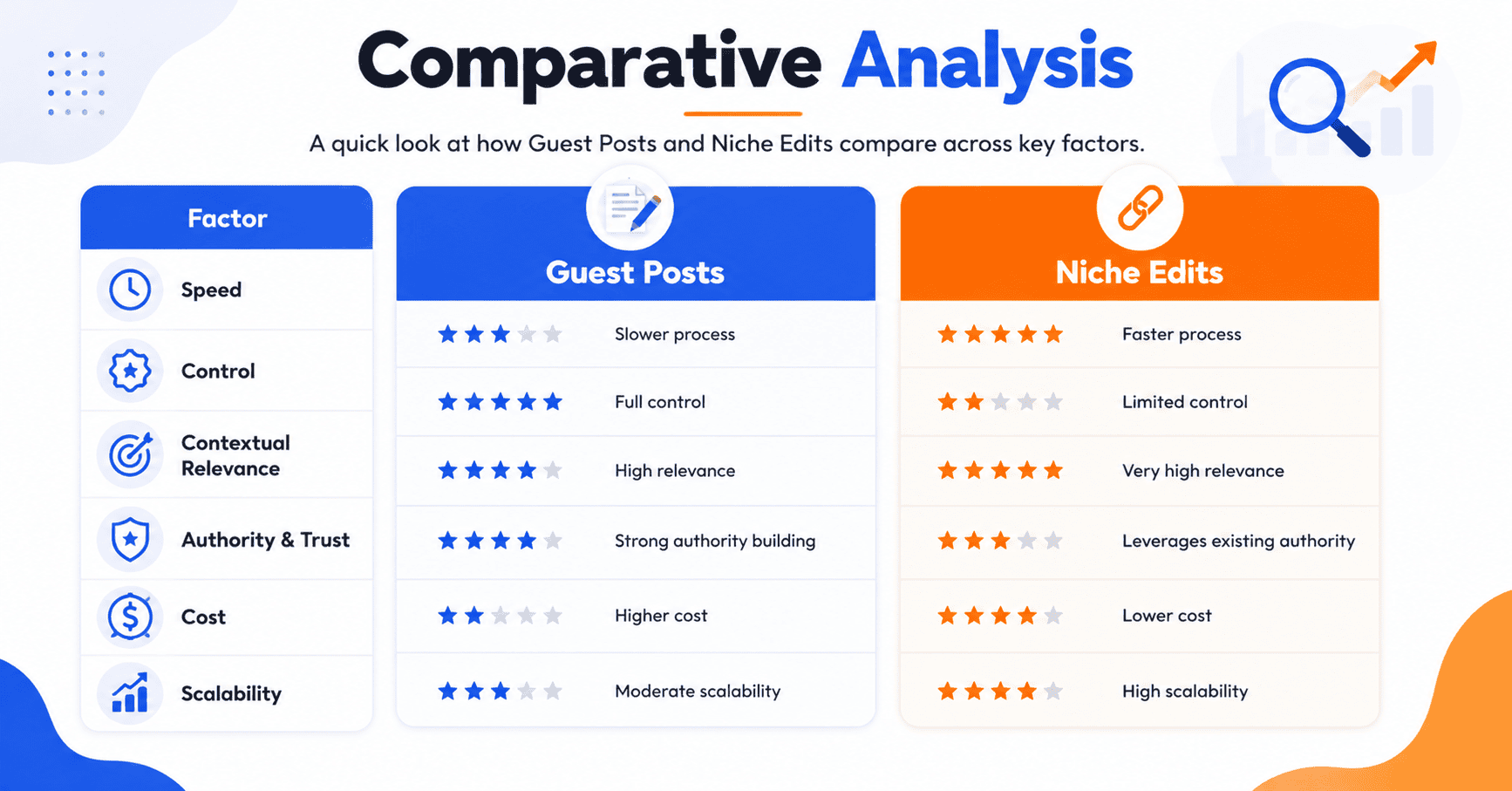
When it comes to content creation and control, guest posts give you full authority over the narrative. You craft the content to align with your brand’s messaging, with consistency and clarity built in from the start.
Niche edits, by contrast, place your link inside content you don’t control. That means less say over tone and context, but faster integration into pages that are already live and indexed.
In terms of authority and trust building, guest posts start from zero — you build authority by publishing new content that demonstrates expertise over time. Niche edits borrow the authority of already-established content, which can make a site look more credible faster, but only for as long as that placement stays live.
On speed of results, guest posts are the slower, long-term play, with benefits that tend to accrue as the new content gains its own traction. Niche edits can move faster because the receiving page has already been indexed and, ideally, already ranks.
Neither approach is inherently “better.” Experienced link builders generally treat niche edits as a way to move quickly on select opportunities, and guest posts as the more durable foundation for a link profile — using both together, rather than picking one exclusively.
Are Guest Posts and Niche Edits Against Google’s Guidelines?

Short answer: not automatically — but how they’re acquired and disclosed matters.
Google’s spam policies don’t prohibit sponsorship or advertising on the web. Google has stated that buying and selling links is a normal part of how the web economy works. What Google’s policies do flag is content created mainly to manipulate ranking signals — including large-scale campaigns of low-quality guest posts or paid placements whose links pass ranking credit without being properly tagged.
A few things are worth knowing before you invest in either tactic:
- Paid or sponsored links should be tagged: If a link is part of a paid placement, Google’s guidance calls for marking it with
rel="sponsored"orrel="nofollow"so it doesn’t pass ranking credit. Sites that publish or acquire large volumes of sponsored or guest-post links without these tags risk algorithmic or manual action. - Vetting matters more than volume: Google’s own search advocates have specifically warned that sites accepting paid guest posts without carefully vetting the content and links can see their rankings affected — not only through link-spam detection, but through broader content-quality systems as well.
- Discounted links don’t “come back.”: If Google’s systems identify a link as manipulative and discount its effect, that benefit doesn’t return even if the link is later removed or fixed. There’s no guaranteed path to recovering value lost this way.
- A single authority score isn’t the same as a Google ranking signal: Domain Authority (Moz) and Domain Rating (Ahrefs) are third-party metrics built from each tool’s own backlink index. Google has repeatedly said it doesn’t use either as a ranking factor — they’re useful for comparing prospects to each other, not proof that a link will move rankings.
None of this means guest posts or niche edits are off-limits. It means the safest version of either tactic looks like genuine publishing, relevant sites, real editorial standards, honest disclosure where money changes hands, and a link that would still make sense on the page even if you removed the SEO motive entirely.
When to Choose Which?
Choosing between guest posts and niche edits depends on your goals, quick visibility, long-term authority, or a tight budget. Here’s how that plays out across three common scenarios.
For New Businesses
If you’re just starting out and need visibility quickly, niche edits can be the faster route. Placing a link in already-established content lets you borrow some of that page’s existing authority instead of waiting for a brand-new article to earn its own.
For Established Brands
If you’ve already built a foundation, guest posts tend to pay off more over time. Creating in-depth, bylined content builds your brand’s authority and reach, and tends to open doors to further relationships with other publishers in your industry — benefits a link insertion alone doesn’t offer.
For Budget-Conscious Marketers
Guest posts typically cost more overall because they include content creation and outreach, not just placement. Niche edits are usually cheaper per link since there’s no new article to produce. If budget is tight and speed matters more than long-term brand building, niche edits are often the more efficient choice.
How to Evaluate a Link Opportunity (Beyond a Single Score)
A high Domain Authority or Domain Rating number isn’t proof a link is worth having. Before committing to a guest post or niche edit, check:
- Real organic traffic: It not just a backlink count — a page with strong metrics but no visitors is passing much less value than it looks.
- Topical relevance: does the surrounding content genuinely relate to your page, or is the connection a stretch?
- Editorial standards: does the site publish content for its own readers, or does it accept anything for a fee?
- How many outbound links the page already carries: A page stuffed with unrelated, paid-looking links is a red flag, regardless of its authority score.
- Anchor text pattern: Natural, varied anchor text reads better to both readers and search engines than repeated exact-match keywords.
Best Practices for Acquiring Links
Whether you’re pursuing guest posts or niche edits, the outcome comes down to strategic outreach, genuine relevance, and real value for the site’s existing readers.
Guest Posts
Start by identifying sites that are relevant to your niche and that regularly publish guest content for an engaged audience. Ahrefs and Semrush are useful for researching a prospective site’s backlink profile and traffic history; BuzzSumo is a good complement for spotting high-engagement content and identifying editors or writers worth pitching directly.
When pitching, keep your email personalized and concise. Address the editor by name, briefly explain why your content fits their audience, and include a few topic ideas that align with what they already publish. Linking to previous guest posts or bylined work helps establish credibility before you’ve published anything on their site.
Tools and resources for outreach and content creation:
- Ahrefs / Semrush — vet a site’s traffic, backlink profile, and content quality before pitching.
- A dedicated outreach or CRM tool (e.g., a shared spreadsheet or outreach platform) — track who you’ve pitched, follow-up dates, and outcomes.
- An editorial brief template — keep pitches, drafts, and publication dates organized across multiple sites.
Niche Edits
Use Ahrefs or Moz to identify sites with genuinely authoritative, currently-performing content — pages that are still driving organic traffic, not just ones with an old, decaying backlink profile. Look for a clear, honest reason your link would improve the page for its existing readers.
When reaching out, be direct about what you’re proposing. Explaining the specific value your link adds — a more current resource, missing data, a genuinely useful reference — tends to get a faster, more receptive response than a generic request.
Tools and resources for managing niche edit campaigns:
- Ahrefs / Semrush / Moz — confirm the target page is indexed, ranking, and receiving real traffic before you commit.
- A link-tracking spreadsheet or tool — log every placement and re-check periodically that the link is still live and still relevant.
- The Wayback Machine — check a page’s edit history to see how frequently it’s updated (frequent edits raise the odds your link could later be removed).
Common Pitfalls to Avoid
Guest Posts
- Choosing sites based on a single authority score without checking real traffic or audience relevance.
- Over-optimized, exact-match anchor text that reads as manipulative rather than natural.
- Writing content around the link instead of for the publication’s actual readers.
- Skipping disclosure on paid placements that should carry a
sponsoredornofollowtag.
Niche Edits
- Targeting old, low-traffic pages because they carry a high authority score.
- Ignoring the quality and relevance of the surrounding content.
- Assuming the placement is permanent — site owners can edit or remove content (and your link with it) at any time.
- Piling onto pages that already host several inserted links from unrelated sites, a sign the page has become a link-selling target rather than a genuine editorial resource.
Final Thoughts
Guest posts and niche edits solve different problems. Guest posts build long-term authority and brand exposure through original content you control. Niche edits offer speed and cost-efficiency by borrowing the authority of content that already ranks.
Neither is automatically the “better” tactic — and neither is automatically safe just because a site has a high authority score. The strongest link-building strategies typically use both, applied selectively, on pages that would be worth linking to on their own merits.
FAQs
Not inherently. Google’s policies target link schemes built to manipulate rankings — large-scale, undisclosed paid links or low-quality content created mainly to house a backlink. A relevant, honestly-disclosed placement on a legitimate site is treated differently than a bulk, unvetted campaign.
Usually, yes. Niche edits skip content production entirely, so you’re generally paying only for the placement. Guest posts include the cost of writing (and often editing and formatting) a full article on top of the placement itself.
Yes — many link-building programs use both: guest posts for durable, long-term authority and brand exposure, and niche edits for faster wins on select, well-vetted pages.



 No publishers in the cart.